
WAS Thickening
InnoFloc™:
WAS Thickening Process
Phosphorus Removal
TSS Removal
BOD Reduction
Overview
What Is InnoFloc?
InnoFloc is a fully automated wastewater conditioning and dewatering system that uses precision inline chemical dosing to prepare wastewater for efficient solids removal. Unlike the InnoCyclone — which uses a separation vessel — InnoFloc conditions the wastewater through coagulation and flocculation, then sends it directly to a dewatering process.
The result is stable, well-formed flocs ready for geotextile bag or roll-off container dewatering — removing phosphorus, TSS, algae, and BOD with minimal operator involvement.
Technology
How It Works
1
Wastewater Inlet
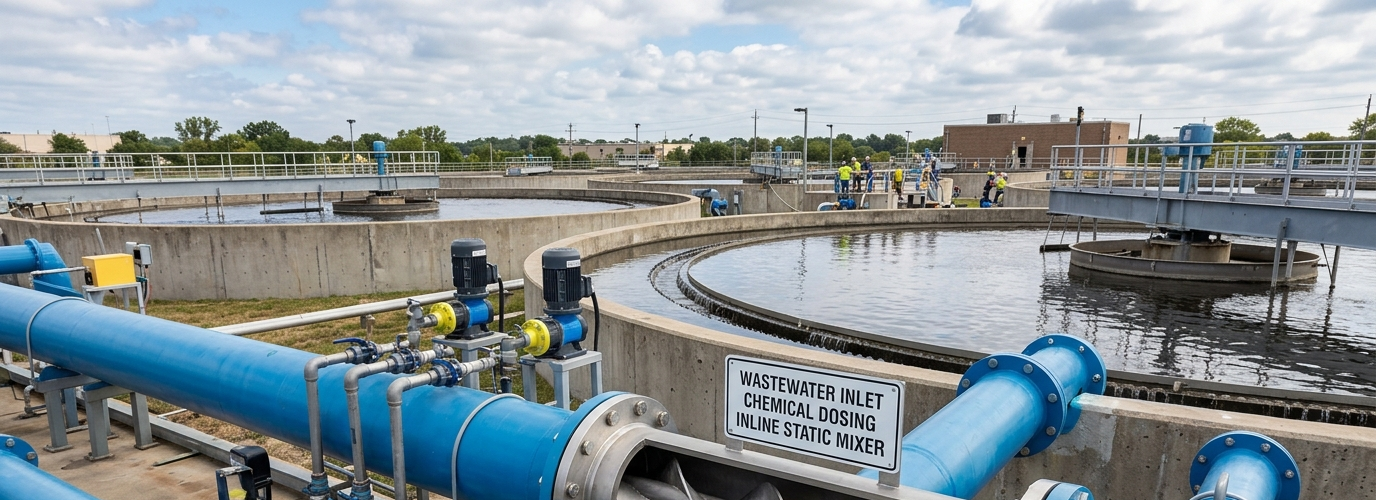
Incoming wastewater — typically Waste Activated Sludge (WAS) or industrial effluent — enters the InnoFloc system.
WAS or Industrial
2
Coagulant Injection
A coagulant (alum or ferric chloride) is precision-dosed into the stream, destabilizing particles and initiating floc formation.
Static mixer
3
Polymer Injection
Static mixer
4
Dewatering
PLC automated
Dewatering
Two Dewatering Options
Geotextile Bag Dewatering
Conditioned wastewater is pumped into geotextile bags placed on the ground or in a roll-off container. Water filters through the bag fabric while solids are retained. Simple, low-cost, and effective for a wide range of wastewater types.
Roll-Off Container Dewatering
Geotextile bags are housed inside a roll-off container for a contained, portable dewatering solution. Ideal for sites requiring easy solids transport and disposal, or where ground space is limited.
Who It's For
Applications
Waste Activated Sludge (WAS)
Municipal wastewater treatment plant sludge conditioning prior to dewatering — improving solids capture and reducing dewatered volume.
Waste Activated Sludge (WAS)
Municipal wastewater treatment plant sludge conditioning prior to dewatering — improving solids capture and reducing dewatered volume.
Industrial Wastewater
Industrial Wastewater
Phosphorus Recovery
Captures phosphorus-rich solids that can be further processed into high-quality fertilizer, turning a waste stream into a valuable resource.
Phosphorus Recovery
Captures phosphorus-rich solids that can be further processed into high-quality fertilizer, turning a waste stream into a valuable resource.
Sludge Management
Integrated with broader sludge management workflows — conditioning, dewatering, and composting for responsible solids disposal.
Sludge Management
Integrated with broader sludge management workflows — conditioning, dewatering, and composting for responsible solids disposal.
Proven Results
Estimated Performance
Contaminant
Estimated Removal Rate
Notes
Total Phosphorus (TP)
85 – 95%
Dependent on coagulant type and dose
Total Suspended Solids (TSS)
90 – 97%
High capture efficiency with polymer addition
Algae
85 – 95%
Effective for most bloom-forming species
Biochemical Oxygen Demand (BOD)
40 – 60%
Indirect reduction through TSS capture
Contaminant
Total Phosphorus (TP)
Estimated Removal Rate
85 – 95%
Notes
Dependent on coagulant type and dose
Contaminant
Total Suspended Solids (TSS)
Estimated Removal Rate
90 – 97%
Notes
High capture efficiency with polymer addition
Contaminant
Algae
Estimated Removal Rate
85 – 95%
Notes
Effective for most bloom-forming species
Contaminant
Biochemical Oxygen Demand (BOD)
Estimated Removal Rate
40 – 60%
Notes
Indirect reduction through TSS capture
* Estimated performance based on similar chemical conditioning systems. Actual results vary with wastewater characteristics and dewatering method.
Technical Overview
The InnoFloc System
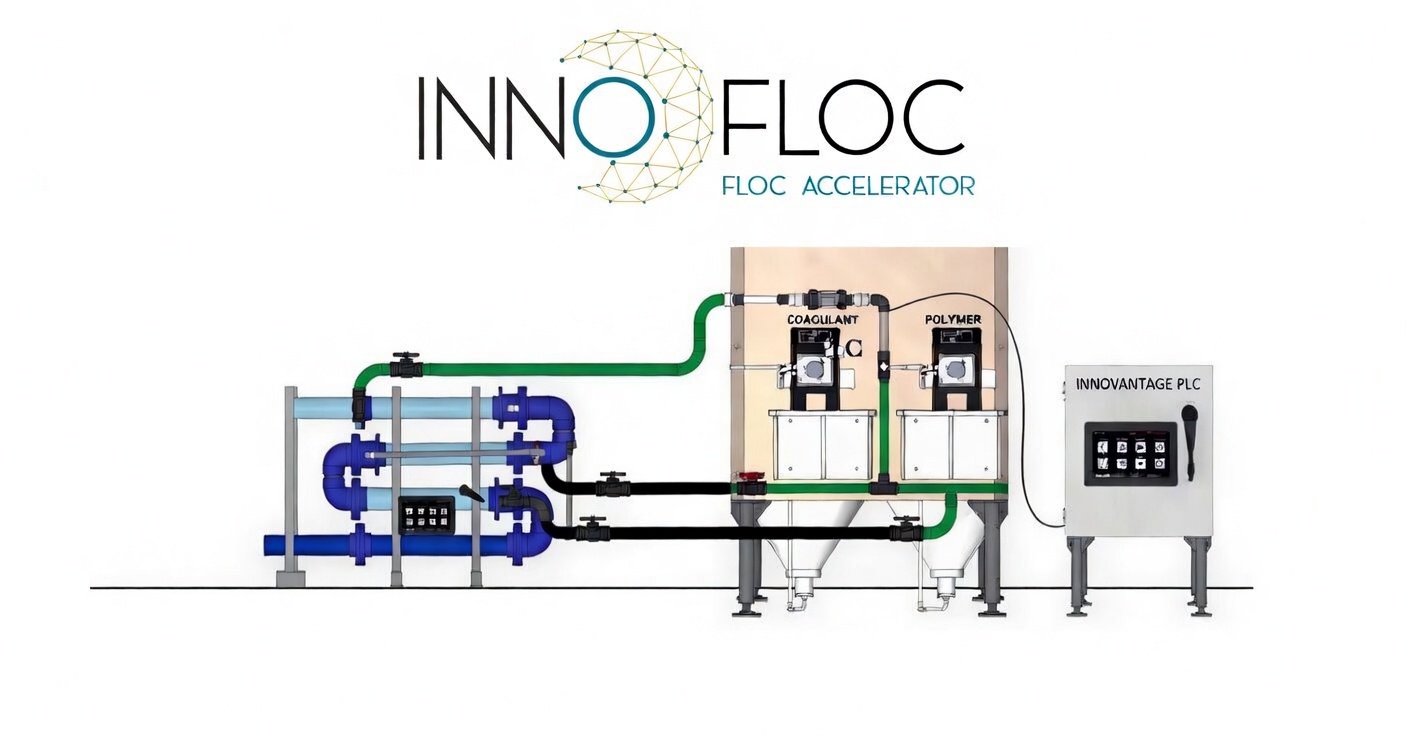
The InnoFloc system: dual static inline mixers, coagulant and polymer precision dosing pumps, collection hoppers, and the Innovantage PLC for full automated control. Compact and modular — integrates readily into existing infrastructure.
Download the InnoFloc Technical Sheet
Full system description, process flow, performance data, features, and advantages — ready for your engineering review.